二次函数Introduction
引言
已知:
y=ax2+bx+c(a=0)
步骤 1:从前两项中提取公因子 a
y=a(x2+abx)+c
步骤 2:在括号内完成平方
=a(x+2ab)2−a(2ab)2+c
步骤 3:化简常数项
=a(x+2ab)2+(c−4ab2)
最终形式:
y=a(x−h)2+k其中 h=−2ab,k=c−4ab2
顶点位于 x=h,函数值 f(h)=k
若 a>0:顶点处为最小值
若 a<0:顶点处为最大值
确定值域Determining Range
情况一:当 a>0 时(抛物线开口向上)
顶点:抛物线的最低点。
值域:所有大于或等于顶点纵坐标的实数。
不等式形式:f(x)≥k
情况二:当 a<0 时(抛物线开口向下)
顶点:抛物线的最高点。
值域:所有小于或等于顶点纵坐标的实数。
不等式形式:f(x)≤k
求解二次方程Solving Quadratics
配方法:
将 f(x) 重写为顶点式。
Example:
Given
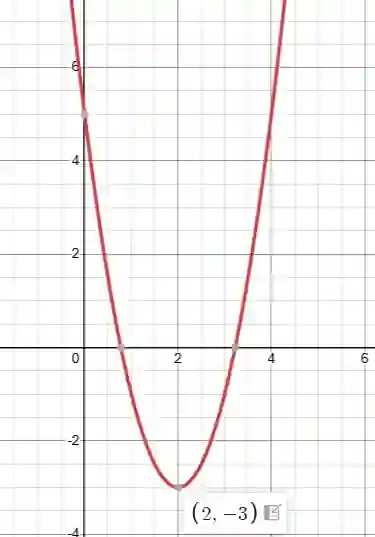
f(x)=2x2−8x+5
Start by factoring out the coefficient of x2 from the first two terms:
2(x2−4x)+5
Take half of the coefficient of x inside the parentheses, (-4), divide by 2 and square it:
(2−4)2=(−2)2=4
Add and subtract this inside the parentheses to complete the square:
2(x2−4x+4−4)+5
Rewrite as a perfect square trinomial:
2((x−2)2−4)+5
Expand:
2(x−2)2−8+5
Simplify:
2(x−2)2−3
The minimum value occurs at
x=2,f(2)=−3
Factorising:
Solve x2−6x+9=0 by factorising.
Multiply the coefficient of x2 and the constant term:
1×9=9
Find two numbers that multiply to 9 and add to -6:
−3 and −3
iv. Rewrite the middle term using -3 and -3:
x2−6x+9=0
v. Split the middle term:
x2−3x−3x+9=0
Group terms:
x(x−3)−3(x−3)=0
vi. Factorise completely:
(x−3)(x−3)=0⇒x=3,;x=3
Quadratic Formula:
Standard Form: ax2+bx+c=0
Compare With: x2−6x+9=0 ⇒ a=1,b=−6,c=9
Input into the quadratic formula: x=2a−b±b2−4ac
x=2⋅1−(−6)±(−6)2−4⋅1⋅9
x=26±36−36
x=26±0=3
判别式Discriminant
通过计算判别式 b2−4ac 来确定根的类型
若 b2−4ac=0,则有实重根
若 b2−4ac>0,则有相异实根
若 b2−4ac<0,则无实根
直线与曲线的交点Intersections of a line and a curve
若联立直线与曲线方程得到一个二次方程,则:
若 b2−4ac=0,直线与曲线相切
若 b2−4ac>0,直线与曲线有两个交点
若 b2−4ac<0,直线与曲线不相交
二次不等式Quadratic Inequality
考虑涉及两个因子乘积的不等式:
(x−d)(x−β)<0
这意味着 (x−d) 与 (x−β) 的乘积为负。
要使两个实数的乘积为负,一个因子必须为正,另一个必须为负。
假设 d<β,这意味着:
[d<x<β]
类似地,考虑不等式:
(x−d)(x−β)>0
这里,乘积为正。
要使两个数的乘积为正,两个因子必须同为正或同为负。
因此,x 位于 d 与 β 构成的区间之外:
[x<d或x>β]
表达式 (x−d)(x−β) 在 x=d 和 x=β 处等于零。
这些点将数轴划分为三个区域:
x<d,d<x<β,x>β
笔记内容基于 ZNotes(znotes.org)0606 Theory,中文译文采用 ZNotes 官方中文翻译,例题保留英文原文。已对照 CIE 0606 大纲(2025–2027)逐主题核验。