方程、不等式与图像Solving Equations
解方程
消元法解方程
1. 形式为:
∥ax+b∥=c
-
其中:c≥0
-
拆分为 两种 情况:
Example: ∥2x−3∥=5
Solution:x=4orx=−1
2.Equation of the form:
∥ax+b∥=cx+d
Example:∥x−2∥=3x+1
-
Case 1:
x−2=3x+1
−2=2x+1
−3=2x
x=−1.5
However, the right-hand side is negative so -1.5 will be rejected.
-
Case 2:
Check if right-hand side is valid (i.e., non-negative):
−(x−2)=3x+1
−x+2=3x+1
1=4x
x=0.25
Solution:x=0.25
3. Equation of the form:
∥ax+b∥=∥cx+d∥
-
Consider four cases:
-
ax+b=cx+d
-
ax+b=−(cx+d)
-
−(ax+b)=cx+d
-
−(ax+b)=−(cx+d)
Example: ∥2x+1∥=∥x−3∥
-
Case 1:
2x+1=x−3
x=−4
-
Case 2:
2x+1=−(x−3)
2x+1=−x+3
3x=2
x=32
-
Case 3:
−(2x+1)=x−3
−2x−1=x−3
−3x=−2
x=32
-
Case 4:
−(2x+1)=−(x−3)
−2x−1=−x+3
x=−4
Solution: x=−4orx=32
4.Equation of the form:
∥ax2+bx+c∥=d
Example: ∥x2−4x+3∥=2
-
Case 1:
x2−4x+3=2
x2−4x+1=0
Use the quadratic formula:
x=2(1)4±(−4)2−4(1)(1)
x=24±16−4
x=24±12
x=2±3
-
Case 2:
x2−4x+3=−2
x2−4x+5=0
Discriminant:
(−4)2−4(1)(5)=16−20=−4
No real solutions.
Solution:x=2+3orx=2−3
Solving Equations by Substitution
Example: x4−5x2+6=0
-
Let:u=x2
-
Then the equation becomes:
u2−5u+6=0
-
Solve the quadratic:
u2−5u+6=0
(u−2)(u−3)=0
So, u=2oru=3
-
Back-substitute:
Since u=x2,
Final solution:x=±2, ±3
绘制三次函数图像Sketching Cubic Graphs
给定一个三次函数,例如:
f(x)=2x3+5x2−7x+1
-
x 轴截距(根):
当函数值等于零时,出现 x 轴截距。
如果函数被因式分解为
f(x)=(x−a)(x−b)(x−c)
那么根就是 x=a,b,c。
-
y 轴截距:
令函数中的 x=0:f(0)=2⋅03+5⋅02−7⋅0+1=1
因此图像在 (0,1) 处穿过 y 轴。
-
三次函数图像的末端行为:
该多项式的次数为 3(奇数次)。
首项系数为 +2(正数)。
对于奇数次多项式:
- 如果首项系数为正,图像在左下方向下降,在右上方向上升。
- 如果首项系数为负,图像在左下方向上升,在右上方向下降。
由于这里的首项系数为 +2,图像行为如下:
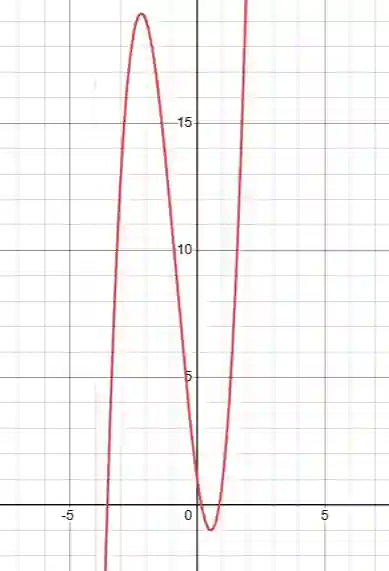
一般规则:
对于奇数次多项式:
- 如果首项系数为正,图像在左下方向下降,在右上方向上升
- 如果首项系数为负,图像在左下方向上升,在右上方向下降
对于偶数次多项式的末端行为:
- 如果首项系数为正,两端都向上
- 如果首项系数为负,两端都向下
求解三次不等式Solving Cubic Inequalities
考虑以下形式的不等式:
f(x)≥d,f(x)>d,f(x)≤d,f(x)<d
其中 f(x) 是三个线性因子的乘积,例如:
f(x)=(x−a)(x−b)(x−c)
且 d 是一个常数。
求解步骤:
-
重写不等式:
将所有项移到一侧以分析符号:
f(x)−d
-
通过解方程求根:
f(x)=d
这意味着:
(x−a)(x−b)(x−c)=d
(x−a)(x−b)(x−c)−d=0
-
求根:
解出满足 f(x)=d 的 x 值:
f(x)=d⇒x1,x2,x3
-
绘制或分析图像:
- 函数在点 x1,x2,x3 处穿过直线 y=d。
- 在根之间,f(x) 的值改变符号(正/负)。
- 由于它是三次函数,符号在根之间交替变化。
-
确定不等式成立的区间:
- 检查根之间的每个区间。
- 根据不等式的类型(大于、小于或等于),识别表达式满足条件的地方。
-
写出解集:
- 基于符号分析,写出不等式成立的区间。
- 根据不等式是严格的 (<,>) 还是包含等号的 (≤,≥),使用开区间或闭区间。
Example:
Solve the inequality:
(x−1)(x+2)(x−4)≤0
Step 1: Find the roots
Set the expression equal to zero:
(x−1)(x+2)(x−4)=0
So the roots are:
x=−2,x=1,x=4
Step 2: Split the number line into intervals
The critical points divide the number line into four intervals:
- x<−2
- −2<x<1
- 1<x<4
- x>4
Step 3: Test the sign of the expression in each interval
Let:
f(x)=(x−1)(x+2)(x−4)
| Interval |
Test value |
Sign of each factor |
Sign of (f(x)) |
| x<−2 |
x=−3 |
(−)(−)(−) |
Negative |
| −2<x<1 |
x=0 |
(−)(+)(−) |
Positive |
| 1<x<4 |
x=2 |
(+)(+)(−) |
Negative |
| x>4 |
x=5 |
(+)(+)(+) |
Positive |
Step 4: Select intervals where the expression is ≤0
We want:
(x−1)(x+2)(x−4)≤0
This means f(x) is either negative or zero.
- Negative in: (−∞,−2) and (1,4)
- Zero at: x=−2,1,4
Final Answer:
x≤−2or1≤x≤4
求解绝对值不等式Solving Absolute Value Inequalities
1. 形式为:
k∥ax+b∥>c(c≥0)
两边同时除以 k>0:
∥ax+b∥>kc
求解:
ax+b>kc,ax+b<−kc
Example: 2∥3x−1∥>4,∥3x−1∥>2
Solve both cases:
Final answer: x<−31,x>1
2.Inequality of the form:
k∥ax+b∥≤c(c>0)
Divide both sides by k>0:
∥ax+b∥≤kc
Which gives:
−kc≤ax+b≤kc
Example: ∥2x+5∥≤3
Solve:
−3≤2x+5≤3
Subtract 5:
−8≤2x≤−2
Divide by 2:
−4≤x≤−1
3.Inequality of the form:
k∥ax+b∥≤∥cx+d∥(k>0)
Split into two inequalities:
k∥ax+b∥≤cx+d
k∥ax+b∥≤−(cx+d)
Example: 2∥3x−1∥≤∥x+4∥
Split into:
4.Inequality of the form:
∥ax+b∥≤cx+d
Split into two cases:
ax+b≤cx+d
−(ax+b)≤cx+d
Also include domain restriction: cx+d≥0
Example: ∥2x−3∥≤4x+1
Split:
Also: 4x+1≥0
Quadratic absolute inequality:
Type 1:
∥ax2+bx+c∥>d
Split into:
ax2+bx+c>d
ax2+bx+c<−d
Example: ∥x2−4x+1∥>2
Split:
Type 2:
∥ax2+bx+c∥≤d
Equivalent to:
−d≤ax2+bx+c≤d
Example: ∥x2−4x+3∥≤5
Rewrite as:−5≤x2−4x+3≤5
Split into:
Graphical Method:
Plot:
y=∥f(x)∥,y=g(x)
Use the graph to visually identify where the inequality holds by comparing which curve lies above or below the other.
笔记内容基于 ZNotes(znotes.org)0606 Theory,中文译文采用 ZNotes 官方中文翻译,例题保留英文原文。已对照 CIE 0606 大纲(2025–2027)逐主题核验。