微积分Differentiation
微分
y=xn
dxdy=nxn−1
dx2d2y=dxd(dxdy)
函数增减的条件:
dxdy>0
dxdy<0
导函数(也称为导数)表示函数的变化率或梯度。
如果 y=f(x),则导函数写作 f′(x) 或 dxdy
注意:f′′(x)=dxd(f′(x))
驻点Stationary Point
区分极大值与极小值点
Example
Classifying Stationary Points of f(x)=x3−3x2+4
-
Find the first derivative:
f′(x)=3x2−6x
-
Find stationary points by setting f′(x)=0:
3x2−6x=0⟹3x(x−2)=0⟹x=0 or x=2
-
Find the second derivative:
f′′(x)=6x−6
-
Evaluate f′′(x) at each stationary point:
-
At x=0:
f′′(0)=6(0)−6=−6<0
Since f′′(0)<0, x=0 is a local maximum.
-
At x=2:
f′′(2)=6(2)−6=12−6=6>0
Since f′′(2)>0, x=2 is a local minimum.
Summary:
x=0 is a local maximum.
x=2 is a local minimum.
微分法则Rules of differentiation
1. 链式法则
若 y 依赖于 u,且 u 依赖于 x,则:
dxdy=dudy⋅dxdu
Example:
Find dxd((3x+2)5)
Let y=u5, where u=3x+2
Then, dudy=5u4, dxdu=3
Sodxdy=5(3x+2)4⋅3=15(3x+2)4
2.Product Rule
If y=uv, where both u and v are functions of x, then:
dxdy=u⋅dxdv+v⋅dxdu
Example: Find dxd(x2sinx)
Let u=x2, v=sinx
Then,
dxdu=2x, dxdv=cosx
Sodxdy=x2cosx+2xsinx
3.Quotient Rule
If y=vu, where both u and v are functions of x, then:
dxdy=v2v⋅dxdu−u⋅dxdv
Example: Find dxd(cosxx2)
Let u=x2, v=cosx
Then,
dxdu=2x, dxdv=−sinx
Sodxdy=cos2xcosx⋅2x−x2(−sinx)=cos2x2xcosx+x2sinx
特殊微分公式Special Differentials
dxdy(sin(ax))=acos(ax)
dxdy(cos(ax))=−asin(ax)
dxdy(tan(ax))=asec2(ax)
dxdy(eax+b)=aeax+b
dxdy(lnx)=x1
dxdy(ln(f(x)))=f(x)f′(x)
微分法的应用Applications Of Differentiation
某点处的梯度
曲线在某点处的梯度即为该点处的导数值:
Gradient at x=a⇒f′(a)
切线方程
曲线在 x=a 处的切线方程为:
y−f(a)=f′(a)(x−a)
法线方程
曲线在 x=a 处的法线方程为:
y−f(a)=−f′(a)1(x−a)
驻点
当导数为零时出现驻点。
f(ˋx)=0
微分的进一步应用Further Applications Of Differentiation
相关变化率
若 x 与 y 通过方程 y=f(x) 相关联,
则变化率 dtdx 与
dtdy 的关系为:
dtdy=dxdy×dtdx
微小变化
若 y=f(x),且 x 的微小变化 δx 引起 y 的微小变化 δy,则
δy≈(dxdy)x=k×δx
积分Integration
引言
积分是微分(求导)的逆运算。
若
dxd(F(x))=f(x),
则
∫f(x)dx=F(x)+c,
其中 c 为积分常数。
对于任意实数 n=−1:
∫axndx=an+1xn+1+c
Example:
∫3x2dx=3⋅3x3+c=x3+c
For n=−1:
∫(ax+b)ndx=a(n+1)(ax+b)n+1+c
Example:
∫(2x+1)3dx=2⋅4(2x+1)4+c=8(2x+1)4+c
特殊积分Special Integrals
∫sin(ax+b)=−a1cos(ax+b)+c
∫cos(ax+b)=a1sin(ax+b)+c
∫sec2(ax+b)=a1tan(ax+b)+c
∫x1=ln∥x∥+c
∫ax+b1=a1ln∥ax+b∥+c
∫eax+b=a1eax+b+c
运动学Kinematics
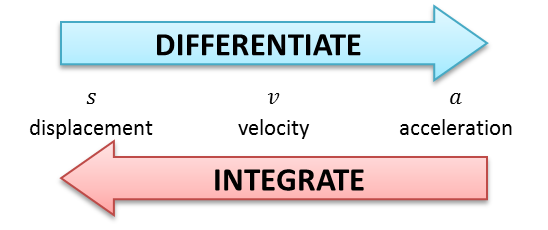
核心概念
v=0
v=0
a=0
位移-时间图
- Y轴:位移 s
- X轴:时间 t
- 斜率:速度=ΔtΔs
- 曲线表示速度变化 ⇒ 存在加速度
- 水平线表示位移恒定(物体静止)
Example:
If displacement increases from 0 to 10 m in 5 s:
velocity=5−010−0=2m/s
Distance–Time Graph
-
Y-axis: Distance travelled (always increasing or constant)
-
X-axis: Time t
-
Direction is ignored, only magnitude matters
-
Gradient:speed=timedistance
-
Steeper line ⇒ higher speed
-
A horizontal line means stationary (no distance added)
Example:
Distance increases from 0 to 100 m in 20 s:
speed=20100=5m/s
Velocity–Time Graph
-
Y-axis: Velocity (can be negative if direction reverses)
-
X-axis: Time t
-
Gradient:acceleration=ΔtΔv
-
Area under graph = displacement
-
Horizontal line = constant velocity
-
Negative velocity ⇒ motion in opposite direction
Example:
Constant velocity of 4 m/s for 6 s:
displacement=4×6=24m
Speed–Time Graph
-
Y-axis: Speed =∥v∥ (always non-negative)
-
X-axis: Time t
-
Area under graph = total distance travelled
-
Used when object changes direction but we care only about total distance
Example:
Speed = 3 m/s for 10 s:
distance=3×10=30m
Acceleration–Time Graph
-
Y-axis: Acceleration a
-
X-axis: Time t
-
Area under graph = change in velocity:
Δv=∫a(t)dx
-
Horizontal line = constant acceleration
-
If acceleration is negative, object is decelerating
Example:
Acceleration = 2 m/s² for 5 s:
Δv=2×5=10m/s
求曲线下方与曲线之间的面积Finding Area Under and Between Curves
1. 求曲线 y=f(x) 与 x 轴之间从 x=a 到 x=b 的面积:
面积=∫abf(x)dx
- 若在 (a,b) 区间上 f(x)≥0,积分直接给出面积。
- 若 f(x) 部分为负,则需分割积分或使用绝对值。
2. 求曲线 y=f(x) 与水平线 y=c 之间的面积:
面积=∫ab∥f(x)−c∥dx
- 必要时,在 f(x)=c 的点处分割积分。
3. 若 y=f(x) 是上方曲线,y=g(x) 是下方曲线,且区间为 x=a 到 x=b
面积=∫ab[f(x)−g(x)]dx
4. 求 y=f(x) 下方从 x=a 到 x=b 的面积:
∫abf(x)dx=F(b)−F(a)
积分常数 +c 在相减时会抵消,可以忽略。
5. 求 y=x2 与 y=x+2 在交点之间的面积。
-
求解交点:
x2=x+2⇒x2−x−2=0⇒x=−1,2
-
确定哪条曲线在上方:
y=x+2>x2 在 (−1,2) 上
-
应用公式:
面积=∫−12[(x+2)−x2]dx⟹∫−12(−x2+x+2)dx
6. 如果:
- y=f(x) 在 (a,c) 上位于 x 轴上方
- y=f(x) 在 (c,b) 上位于 x 轴下方
那么:
总面积=∫acf(x)dx+∫cbf(x)dx
或者:
面积=∫ab∥f(x)∥dx
7. 用 y 而非 x 表示的面积求法:
- 将方程重新排列为 x=f(y) 的形式。
- 对 y 积分:
∫cdf(y)dy
- 计算:
∫cdf(y),dy=F(d)−F(c)
8. 如果区域在 x=c 处被分割,则:
面积=∫acf(x)dx+∫cbg(x)dx
在以下情况使用此公式:
笔记内容基于 ZNotes(znotes.org)0606 Theory,中文译文采用 ZNotes 官方中文翻译,例题保留英文原文。已对照 CIE 0606 大纲(2025–2027)逐主题核验。